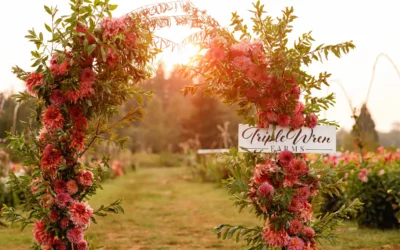
From July-September we ship thousands of dahlia bunches every week to wholesalers and grocery chains. I well remember the days when I delivered buckets out of the back of our station wagon, but our business has grown up fast, and as a result this growth we’ve worked through a huge learning curve of efficiency and practical knowledge.

If you are looking to expand into dahlias as a mass merchandising crop, here is our best advice for processes, infrastructure, and recommended varieties that have worked well for us at Triple Wren.
Dahlias do not have an extremely long shelf life. They’re a very perishable product.
This fact means that we do our best to harvest them at their prime, give them excellent post-harvest care, ensure that logistics continue that care, and get them into their retail environment as quickly as possible. To achieve this, we

- Water well the evening before harvest to ensure a super-hydrated cut.
- Harvest only between sunrise and 10:30AM so that cuts stay cool.
- Harvest directly into clean buckets with cold water + a 1/4th of the recommended rate CVBN tab from Chrysal (we buy directly from the company) to increase acidity (which aids water take-up) and act as a bactericide.
- Move buckets directly from the field into a 40º cooler for at least a 12-hour conditioning period before shipping.
- Choose logistics suppliers with refrigerated trucks so that the chilling time is not interrupted on the way to retail environment.
- Choose reliable logistics suppliers who will pick up on time and care for the flowers en route.

Before we moved too many flowers to handle them ourselves in our our 1980’s station wagon (then na old Ford pickup truck with a hand-me-down topper) we always transported them when it was dark outside in order to keep them as cool as possible. We have found that allowing our dahlias to heat back up to room temp and then be re-chilled at any point in the process after picking drastically reduces their shelf-life/vase-life.
Avoiding this scenario and sticking to our cold-chain standards gives us an excellent product and a reputation for consistency.
We expect our dahlias to last 1-2 days transport/on-the-shelf + 4-5 days in a post-purchase home environment after they leave the farm.

Note: Before moving to hiring logistics companies to transport/deliver for us, we purchased a refrigerated 20′ box truck to haul our blooms, but after a few years of deliveries, when we crunched numbers on Steve’s time to deliver + gas + truck maintenance we realized that a better (profit-driven) choice for our business plan was to outsource this slice of our lives. On paper, the money is just about the same, but there is so much more to consider when refining your Business Plan. We asked questions like, “Is this activity best for our family/Steve’s health?” and “Is this the best use of Steve’s strengths/gifts/time?” Or another way of putting it – “Would we pay someone a CEO salary to drive a box truck?” {Nope.} We want to get to the point where we are working ON our business more than IN it for so many reasons – more on that later – but stating that as one of our personal leader-mission-statements, and then letting that goal inform our Business Plan, trickles down into so many basic business operation decisions. We can move with purpose when we set goals, then work big-to-small to plan, implement/achieve them.

Another important aspect of providing dahlias as a successful mass merch/market crop is how you approach marketing them. From packaging to clearly communicating what you have available/when, to building relationships with buyers and merchandisers, this can be a complicated step.
In talking with many growers, I’ve found that many of us are intimidated by this step, and can tend to neglect giving it the time it deserves, or even ignore it altogether. I’m here today to tell you: that is a mistake that will impede the growth of your business. Exactly how you market is up to you, but you need a solid plan for success.


If you’re not sure how to start, spend an hour brainstorming potential marketing plans (e.g. cold calls, setting up appointments, creating digital or cardstock-printed color cards as gifts for buyers so they have your dahlias right on their desks when they need to order, sample buckets, a sips+treats sunset field tour evening for buyers/florists in your area, make [and stick to!] a good social media plan, etc.) and chose 2-3 to try.
Eliminate the inertia and just work hard to get the word out about your beautiful product.
Once you begin to establish relationships, maintain them. Find out how your buyers want the dahlias to arrive (in a box with a barcode? Just in buckets? Bunched or loose? How many bunches per bucket?) Ask for quality feedback, but don’t be a doormat: do your homework to know the prices that are fair in your region, and price your product accordingly, never undercutting other growers. I’m a firm believer that a rising tide floats all boats. Choose a collaborative mindset over a competitive one whenever possible.


There are volumes I could write on this subject, and I’m working on lots more posts for the winter and exploring putting together a short online course about how we approach flower business planning, but for now I’ll move on to some of our favorite varieties for market/grocery dahlias. After all that practical theory, we need some beauty right about now!
There are a few essential traits that a dahlia plant/bloom has to exhibit before we’ll allow it into our grocery program. Beyond being general healthy of course, we choose to ship dahlias that have reliably strong stems, that are decorative form (usually balls or pompons), and that have about 3.5″-4″ heads.

Note: We used to flex more with each buyer’s demands, but now we only offer 8-pack buckets (meaning 8 bunches of dahlias per bucket), and we work to make sure each bunch is about the same size and heft. (So if we’re picking a pom like Chick-a-Dee then we’ll need 8-10 stems, or for a smaller ball like Cornel Bronze or Rose Toscano we might need 6-7 stems, but a 3.5″ ball like Linda’s Baby needs 5 stems. Some varieties that are very durable don’t always make our grocery cut simply because they’re too big and can throw off our uniformity goals {All that Jazz, Bloomquist Jody Lynn or Alan, Castle Drive, Sweet Nathalie, Bacardi}.) Grocery buyers like to purchase products that have consistency (think rows of factory tomato sauce cans and glowing waxed produce), so we work hard to train our crew to pick bunches that are a standard height and have roughly the same amount of foliage so that the weight (heft) feels uniform. For most of our mass merchandise customers, we do mix colors within the buckets (i.e. 2 orange bunches, 3 yellow bunches, 3 pink bunches), but some (especially floral wholesalers) like getting solid color buckets. Ask your contacts and do your best to meet their needs (without creating unnecessary work/headache for yourself!).

The best (and prettiest) way I can think of to let you know our favorite varieties for grocery is to walk through the rainbow, so by basic color group, here are our top favorites based on productivity and durability:
- Pink/Coral: Rebecca Lynn, BLQ Wonderful, Linda’s Baby, Burlesca, Bloomquist Curt, Bloomquist Dave, Jowey Winnie, Sweet Nathalie, KA’s Keltie Rose
- Red: Cornel, Tahoma Velvet, Chimacum Nadjae, Robinhood, Chick-a-Dee, KA’s Cardinal, KA’s Rosie Jo
- Orange/Peach: Jowey Nicky, AC Firefly, Jowey Chantal, Terracotta (it’s rare to find such a durable cactus form, but they’re great), Cornel Bronze, Amber Queen, Hy Suntan, Rose Toscano
- Yellow/Honey: Golden Scepter, Bloomquist Sue, Hollyhill Spreckles, Crichton Honey, Blyton Softer Gleam, Valley Tawny, BLQ Evening Glow, Sandia Susan (this is a waterlily form, but it’s very durable)
- Purple/Lavender/Plum: Jessie G, AC White Rabbit, Mary Munns, Bluetiful, Irish Speckles, Bistro, Hollyhill Liz, Martina, Bloomquist Compare, Bloomquist Awesome, Snoho Sonia, Sandia Nocturne
- Chocolate: Lights Out, Shadow Cat, Moor Place, Karma Choc
- White: Orsett Beauty, l’Ancresse, White Swan, BLQ Snowy, Salish Snow Day, White Aster, Sandia Icicle, Vista Jake (It’s a novelty form, but it’s very durable)
- Bicolor/Tricolors: Foxy Lady, Valley Rustbucket, Skipley’s Spot of Gold, Bloomquist Fredene, Bloomquist Jerry
I hope this loooong post has been helpful if you’re trying to decide IF you should add a mass merchandise dahlia program to your business, and WHAT we recommend growing to have a balanced color palette of reliable varieties. We are excited that you’re following along on our journey, and cheering for you in yours. Let us know in the comments if you have specific questions or feedback!