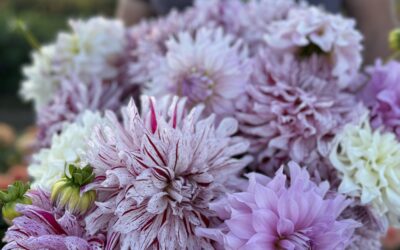
The heritage of your dahlia seeds determines the quality of your seedlings. Here at Triple Wren, we do our best to make sure that our dahlia seed is gathered from strong plants and that it has been pollinated and ripened, and we don’t have trouble with poor germination. We primarily harvest seed from fully double seed-parents, so that our dahlias have a greater chance of carrying the dominant trait of their “mothers'” forms.
Given double-on-double crosses, your chances of getting a fully double seedlings are higher.
It might seem obvious, but a seedling garden with lots of open-centered dahlias (think Apple Blossom, Bloomquist Simple, and Totally Tangerine) will tend to produce more open-centered seedlings than a dahlia patch that is planted only with fully-double dahlias. Pollinators can more easily reach the reproductive bits of open-centered flowers, and because that pollen is more readily available, you can see how having those genetics disproportionally available in your seedling patch will lead to more open centers in your saved seeds.
If you’d like to save your own dahlia seeds, we have lots of resources right here on our blog. I’ve also written about The Art of Saving Dahlia Seeds, which shares how some experienced hybridizers find the results they want from their dahlia seeds, and you might also find very helpful.
Want to learn even more? In our online membership community The Garden, we have an expanding section called the “Hybridizer Hub” that’s devoted to understanding dahlia pollination, seed saving, and how we assess which dahlia seedlings are “keepers.” It’s designed just for people who are interested in starting to hybridize their own dahlias, and we’d love to invite you to join for even more rich education on hybridizing dahlias.