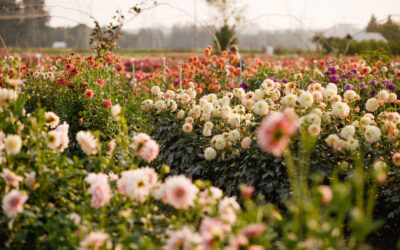
Did you know that the American Dahlia Society (ADS) has created 10 color groups + 5 color blends to categorize dahlias? Dahlias bloom in such an incredible spectrum of colors! Because of the amazing genetic diversity contained in the DNA of these glorious plants, hybrid seed crosses can produce every color except blue and the more brilliant tones of green.
Because the ADS includes a wide array of hues in each color group, we use extra descriptors like blushy, creamy, coral, peach, chocolate, coppery, and plum on our website to help our gardening friends really understand what color blooms they can expect from the tubers and plants we sell.
How is dahlia color determined?
The ADS has given guidelines to their qualified judges of new seedling introductions to determine dahlia color. If you are not entering the dahlia world through the ADS, you can still use this fabulous method as a standard to work from: To begin, the ADS has published a Color Guide for Classifying Dahlias (you can purchase here) that includes the groups we’ll discuss below. In a dry space, with natural light (but not direct sunlight), you can stand about 3 feet back from the dahlia you’re trying to classify and view it through the color guide. The Guide is organized by color family, and contains multiple perforated color “chips” per family. Viewing a dahlia through the perforations helps you make the best match possible to categorize it.
If your dahlia has multiple colors or does not fit into any one color family, it may be a Blend. Keep reading to learn more about each color family and the beautiful worlds of Light Blend, Dark Blend, Flame Blend, Bi-Color, and Variegated dahlias!
We grow dahlias here at Triple Wren that fall into all 10 of the ADS color groups:
The White color group includes pure white, gray-white, creamy tones, minty-green whites, and even the palest lavenders (like the Vista Jake, Lady Liberty, Orsett Beauty, and Salish Snow Day below).

The Yellow color group includes all shades of yellow from neon highlighter yellow to pale butter yellow to deep, golden yellows (like the Irish Moon, Arctic Gold, BLQ Peaceful, BLQ Winner, BLQ Lace, and BLQ Barbara below).

The Orange color family includes a very wide array of color, from pure orange to pale peach to salmon to coral to deep, rusty orange (like the Ms Honey, BLQ Egypt, Jowey Nicky, Nicholas, BLQ Jean, BLQ Octopus, RobAnn Creamsicle, and KA’s™ Blood Orange below).

The Pink category contains perhaps the widest array of colors, from palest blush and baby pink to bubblegum pink and even some salmon tones (like the American Dawn, Linda’s Baby, Wizard of Oz, BLQ Pink Parfait, Café au Lait, Irish Candy, and KA’s™ Keltie Rose below)

The Dark Pink category includes some darker salmon, medium pink, hot pink, fuchsia pink, and even mauve (like these Chimacum Nadjae, KA’s™ Rosie Jo, BLQ Mojo, Islander, Bracken Rose, and Belle of Barmera below).

The Lavender color family includes slightly darker lavender than qualifies for the White category, light purple, blue-ish purples, darker mauve, and orchid (like the Sandia Shomei, BLQ Fruity Drink, BLQ Pincushion, Salish Twilight Girl, Sandia Flirt, and Tahoma Kelli below).

The Red color family includes “American” Red, deeper salmon, brick red, carmine, and crimson reds (like KA’s™ Cardinal, BLQ Curt, BLQ York, Cornel, BLQ Jana, Salish Red Red Red, and Sandia Red Cloud below).

The Dark Red category is self-descriptive, including dark versions of all the colors in the Red family and extending through what might be described as brown to dark chocolate (like the Rip City, BLQ Crave, Tahoma Velvet, BLQ Quill, and BLQ Richard below).

The Purple color family is quite broad and includes darker orchid tones, hottest fuchsias, true purple, deep plum, and almost-black dahlias (like the Fidalgo Knight, BLQ Award, BLQ Vivian R, Bluetiful, Sandia Bertha, and Wyn’s Feisty Freda dahlias below).

The Bronze color family (perhaps my favorite!) includes warm peach, dark mustard, copper, orangey-browns, and some salmon-like tones (like the Hy Suntan, Cornel Bronze, Brown Sugar, Ferncliff Copper, BLQ Pleasing, Terracotta, and Sierra Glow dahlias below).

Besides the solid color groups, the ADS has classifications for 5 types of beautiful “blends.”
Light Blends are blooms that are predominantly lighter pinks, yellows, lavender, and other pastels (like the Sandia Bliss, Hollyhill Pinkie, AC Ben, BLQ Cream, and BLQ Pumpkin dahlias below).

Dark Blends are made up of colors that are less brilliant, like dark reds, purples, dark pinks, oranges, and bronzes (like the KA’s™ Keltie Cherry, All That Jazz, Vista Minnie, Labyrinth, and Foxy Lady dahlias below).

Flame Blends are VERY brilliant, with yellows + reds or yellows + oranges like Jowey Chantal, , Kasasagi, BLQ Tracy G, BLQ Creation, BLQ Georgia C, and BLQ Flare.

Bicolor dahlias have 2 or more distinct, separated colors, like the BLQ Firecracker, Peaches n Cream, Polka, Irish Blackhart, and BLQ Candy Corn dahlias below.

Variegated dahlias have blooms with 2 or more distinct, contrasting colors, where one color appears as flecks, dots, or striations on the petals, like the Sandia Cancan, Hollyhill Spreckles, AC Paint, Irish Speckles, AC Firefly, Ms Zelda dahlias below.

Keep in mind that dahlias can bloom in drastically different colors depending on the day length and also the heat at different times of the growing season. Soil composition can also radically affect bloom color. (Find more on dahlias and soil here.) Because of these factors, being sure you know how a particular variety will perform for you takes at least a year of growing experience in your own microclimate.
Sometimes dahlias are judged at an ADS event and categorized in a way that can be surprising. For example, the color of Rose Toscano dahlias is very similar to Terracotta dahlia’s color in my garden, but Rose Toscano is categorized in the Pink family, and Terracotta is categorized in the Bronze family. Another example is American Dawn, which I might have categorized as Dark Blend, Dark Pink, or Bronze, but it is also considered Pink based on how it was first scored/judged.
The process for categorizing color through the ADS is not perfect, but there does exist a pathway for appealing the initial color selection if needed. The amazing categorical work that the ADS has accomplished over the past one hundred plus years is extremely valuable in many different realms (genomic study, commerce, modern hybridization and more), and North American gardeners’ work with dahlias stands out globally as an model example of progressive approach to organization and categorization among all areas of botanical interest!
How many color families are you familiar with? Which is your favorite category?
Want to learn more about growing dahlias?
The Garden is a positive online membership community offered by Triple Wren Farms. Membership includes:
- – First access to TWF tuber, rooted cuttings, and seed sales
- – A wealth of flower garden How-To topics
- – Frequent seasonal Live Trainings and Q&A’s
- – Our “Anyone Can Grow Dahlias” Online course
- – Personalized gardening advice
- – Encouraging gardening community and more… Just Visit our website to find details and join The Garden!